
Blog Details
10 PHP Best Practices Every Developer Should Follow in 2026
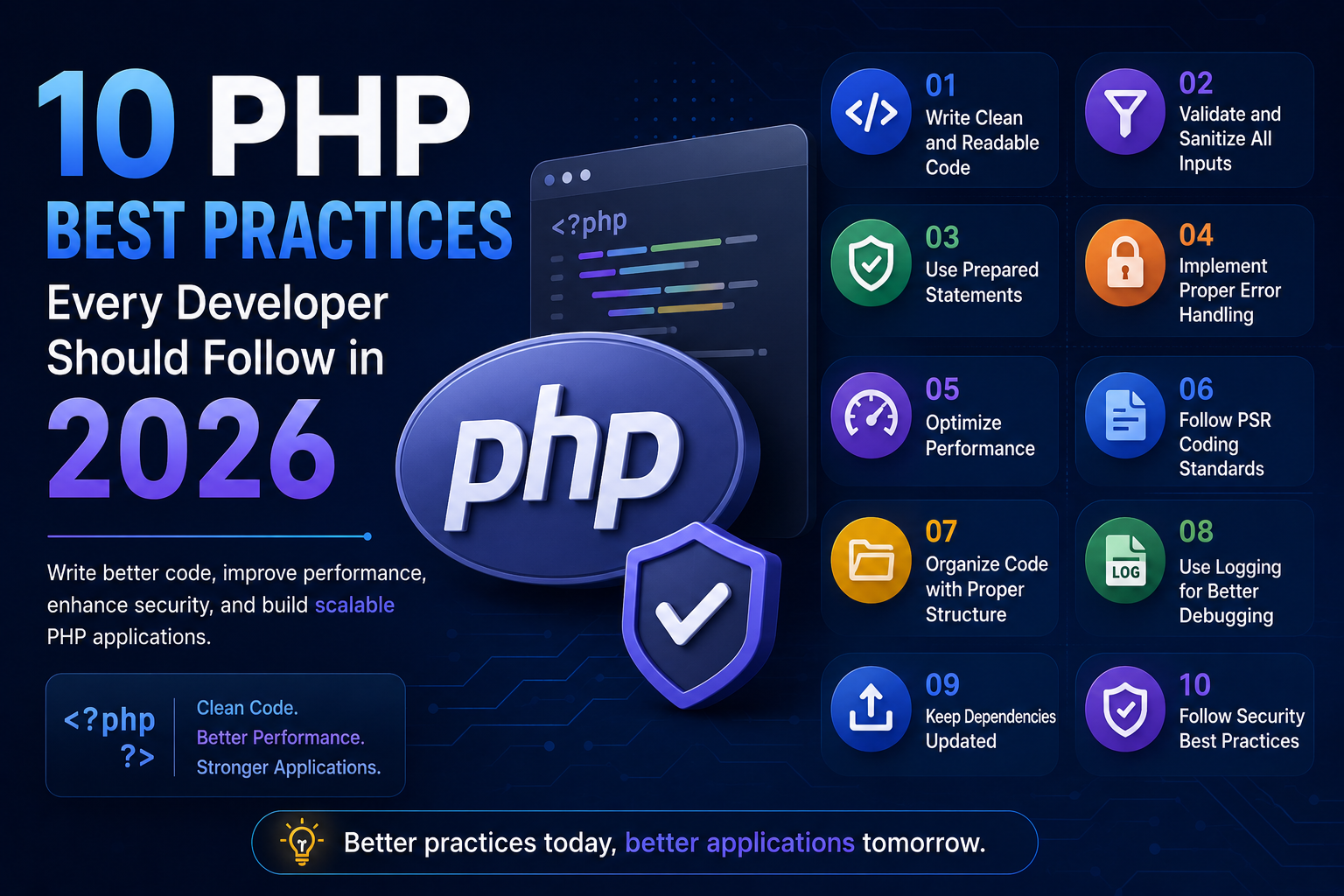
PHP has remained one of the most popular server-side programming languages for decades, powering millions of websites and applications worldwide. Whether you're building a simple website or a large-scale web application using Laravel or Core PHP, following best practices makes your code cleaner, more secure, and easier to maintain.
In this article, I'll share ten essential PHP best practices that every developer should follow.
1. Follow PSR Coding Standards
PHP Standards Recommendations (PSR) provide a consistent coding style that improves readability and collaboration.
Some commonly used standards include:
- PSR-1: Basic Coding Standard
- PSR-4: Autoloading Standard
- PSR-12: Extended Coding Style
Using these standards helps ensure your code is organized and professional.
2. Always Validate and Sanitize User Input
Never trust user input.
Validate all incoming data and sanitize it before processing or storing it in your database.
Example:
$email = filter_input(INPUT_POST, 'email', FILTER_VALIDATE_EMAIL);
if (!$email)
{ die("Invalid email address.");
}
Proper validation helps prevent security vulnerabilities and unexpected application behavior.
3. Use Prepared Statements
SQL Injection remains one of the most common security issues.
Instead of concatenating SQL queries, always use prepared statements.
Example using PDO:
$stmt = $pdo->prepare("SELECT * FROM users WHERE email = ?");
$stmt->execute([$email]);
Prepared statements automatically escape user input and greatly improve application security.
4. Organize Your Code
Avoid putting all logic into a single file.
Separate your application into:
- Controllers
- Models
- Views
- Services
- Helpers
A well-structured project is easier to maintain, debug, and scale.
5. Never Store Passwords in Plain Text
Passwords should always be hashed before saving them.
PHP provides built-in functions for this:
$password = password_hash($password, PASSWORD_DEFAULT);
To verify:
password_verify($password, $hashedPassword);
Never use MD5 or SHA1 for password storage.
6. Handle Errors Properly
Don't display raw PHP errors on production websites.
Instead:
- Log errors
- Show user-friendly messages
- Use try-catch blocks for exceptions
Example:
try { /
/ Database operation
}
catch (Exception $e) {
error_log($e->getMessage());
}
Proper error handling improves both security and user experience.
7. Use Composer for Dependency Management
Composer is the standard dependency manager for PHP.
Instead of manually downloading libraries, install them with Composer:
composer require monolog/monolog
Benefits include:
- Automatic updates
- Autoloading
- Version management
- Easier maintenance
8. Keep PHP and Dependencies Updated
Running outdated versions of PHP can expose your application to security vulnerabilities.
Regularly update:
- PHP
- Composer packages
- Frameworks
- Third-party libraries
Newer versions often provide better performance and security improvements.
9. Write Reusable Code
Avoid repeating the same logic multiple times.
Instead:
- Create helper functions
- Build reusable classes
- Use traits when appropriate
- Follow the DRY (Don't Repeat Yourself) principle
Reusable code saves development time and reduces bugs.
10. Use Version Control with Git
Every professional PHP developer should use Git.
Benefits include:
- Track code changes
- Collaborate with teams
- Roll back mistakes
- Manage releases efficiently
Platforms like GitHub and GitLab make collaboration much easier.
Final Thoughts
Writing PHP code is easy, but writing clean, secure, and maintainable PHP code requires discipline and good development practices. By following these ten best practices, you can build applications that are easier to manage, perform better, and remain secure over time.
Whether you're working with Core PHP, Laravel, CodeIgniter, or another PHP framework, these principles will help you become a more effective and professional developer.
Happy coding!